<?xml version="1.0" encoding="UTF-8"?><feed
	xmlns="http://www.w3.org/2005/Atom"
	xmlns:thr="http://purl.org/syndication/thread/1.0"
	xml:lang="en-GB"
	>
	<title type="text">David Moran</title>
	<subtitle type="text">Architect</subtitle>

	<updated>2021-02-01T11:42:24Z</updated>

	<link rel="alternate" type="text/html" href="https://davidmoran.ie" />
	<id>https://davidmoran.ie/feed/atom/</id>
	<link rel="self" type="application/atom+xml" href="https://davidmoran.ie/feed/atom/" />

	
	<entry>
		<author>
			<name>David_Moran_Architect</name>
					</author>

		<title type="html"><![CDATA[Linear City.]]></title>
		<link rel="alternate" type="text/html" href="https://davidmoran.ie/opinion/linear-city/" />

		<id>https://davidmoran.ie/?p=4684</id>
		<updated>2021-02-01T11:42:24Z</updated>
		<published>2021-02-01T11:42:24Z</published>
		<category scheme="https://davidmoran.ie" term="Opinion" />
		<summary type="html"><![CDATA[Linear City.  Again!  A concept that purports to solve the human problem.  The human problem is that we impact negatively on nature, on our world and on our own prospects for survival.  The problem solved is very clearly that we live with nature and not in control, for if anything of the past year has educated us, Covid-19 has emphasised&#160;<a href="https://davidmoran.ie/opinion/linear-city/" class="read-more">Continue Reading</a>]]></summary>

					<content type="html" xml:base="https://davidmoran.ie/opinion/linear-city/"><![CDATA[<p>Linear City.  Again!  A concept that purports to solve the human problem.  The human problem is that we impact negatively on nature, on our world and on our own prospects for survival.  The problem solved is very clearly that we live with nature and not in control, for if anything of the past year has educated us, Covid-19 has emphasised the fact that we do not control nature.  We are as much part of it as the smallest life form and clearly seek to impact on it more than the largest.  Urban development can be likened to a ‘wall’ another concept rearing its’ ugliness in recent times.  Both a concept and a physical reality that divides communities as had the Berlin wall until relatively recently.  We interpret this as a division of things human, communities, families and neighbourhoods.  It also divides communities in nature, fauna and flora alike.  We actively create conditions where nature evolves a response that weakens biodiversity.  Mohamed bin Salman correctly questions, “Why should we sacrifice nature for the sake of development?” Inadvertently, answering this in the seeking to demonstrate our superiority and actions in putting humanity first.  The Arabian proposal is a linear city 170 kilometres long separating a coastal region from a desert, dividing parts of the desert in a series of modules linked by a route in which it is intended a million people will live.  This in an area that for millennia has remained low density with settlements linked by camel trains and routes, later roads and mechanised transport.  The need to link societies for trade and the sharing of ideas has generated with it a need to control the passage that permits our societal evolution.  To paraphrase many with a question, (David Attenborough, Jared Diamond, etc.)  are we consuming our world to destruction?  We constantly seek to settle new lands to facilitate our expanding population.  The irrigation of Southern Jordan in the Wadi Rum desert, using an aquifer below the desert that has had an accelerating depletion consistent with anthropogenic expansion culminating in todays’ farming.  This according to the Disi Water company in Southern Jordan is likely to last only another fifty years.  Assuming the linear city has sufficient size and spaced openings to avoid interference with the ecology with particular regard to flora and fauna, it remains unlikely that local peopled communities will have no impact.  Recreational use of areas surrounding modules will have an impact, the modules will have facilities providing for residents, will cause shadows and impacts alien to the location.  Waste from the modules, sewage and refuse will either need to be treated or transported.  Successful treatment of waste water will create micro environments that will change the ecology and impact on flora and fauna.  A million people will need water for daily hygiene and consumption and similar to providing hydration for food in the Wadi Rum, will likely deplete the associated aquifer.  Is it intended to use treated sea water?  Is it intended that treated waste water will be returned to the sea, thereby impacting less than on land.  This of itself poses a problem to the bio-diversity of the sea. What happens if the project fails?  What happens if the water runs dry?  Technology is developing to solve these problems, and a deep evaluation of all impacts of solutions prior to constructing a linear city, anywhere is needed.  While a solution to the ever expanding requirement for human settlement is required, we must seek to live with and not in control of nature for the later is a illusion.  Grandiosity in a project is not sufficient to warrant proceeding and of course, nature should not be sacrificed for the sake of development.</p>
<p><a href="https://www.archdaily.com/955079/saudi-arabia-unveils-plans-for-hundred-mile-long-linear-city">https://www.archdaily.com/955079/saudi-arabia-unveils-plans-for-hundred-mile-long-linear-city</a></p>
<p><a href="https://www.pnas.org/content/98/10/5433">https://www.pnas.org/content/98/10/5433</a></p>
<p><a href="https://atalayar.com/en/content/mohamed-bin-salman-presents-line-co2-free-city-will-redefine-urban-development">https://atalayar.com/en/content/mohamed-bin-salman-presents-line-co2-free-city-will-redefine-urban-development</a></p>
<p>Jaren Diamond – Collapse.</p>
<p><a href="https://www.wired.com/story/the-ongoing-collapse-of-the-worlds-aquifers/">https://www.wired.com/story/the-ongoing-collapse-of-the-worlds-aquifers/</a></p>
<p><a href="https://www.designboom.com/architecture/saudi-arabia-the-line-smart-cities-without-cars-01-12-2021/">https://www.designboom.com/architecture/saudi-arabia-the-line-smart-cities-without-cars-01-12-2021/</a></p>
<p><a href="https://civa.brussels/en/exhibitions-events/superstudio-migrazioni">https://civa.brussels/en/exhibitions-events/superstudio-migrazioni</a></p>
<p><a href="https://www.theguardian.com/artanddesign/2021/jan/21/building-big-as-world-superstudio-anarchist-architects-who-foresaw-rampant-expansion-saudi-arabia-linear-city">https://www.theguardian.com/artanddesign/2021/jan/21/building-big-as-world-superstudio-anarchist-architects-who-foresaw-rampant-expansion-saudi-arabia-linear-city</a></p>
]]></content>
		
					<link rel="replies" type="text/html" href="https://davidmoran.ie/opinion/linear-city/#comments" thr:count="0" />
			<link rel="replies" type="application/atom+xml" href="https://davidmoran.ie/opinion/linear-city/feed/atom/" thr:count="0" />
			<thr:total>0</thr:total>
			</entry>
		<entry>
		<author>
			<name>David_Moran_Architect</name>
					</author>

		<title type="html"><![CDATA[Linear or Circular]]></title>
		<link rel="alternate" type="text/html" href="https://davidmoran.ie/opinion/linear-or-circular/" />

		<id>https://davidmoran.ie/?p=4679</id>
		<updated>2021-01-08T10:11:13Z</updated>
		<published>2021-01-08T10:11:13Z</published>
		<category scheme="https://davidmoran.ie" term="Opinion" />
		<summary type="html"><![CDATA[Linear or Circular. A linear economy is a straight line where that discarded is forgotten, an economy where consumerism is a requirement.  Products (often including buildings) are produced with a built-in obsolescence and/or an absence of durability that require them to replaced.  We are familiar with the requirement to repurpose old buildings, which when new suited the now outdated use&#160;<a href="https://davidmoran.ie/opinion/linear-or-circular/" class="read-more">Continue Reading</a>]]></summary>

					<content type="html" xml:base="https://davidmoran.ie/opinion/linear-or-circular/"><![CDATA[<p>Linear or Circular.</p>
<p><img fetchpriority="high" decoding="async" class="alignnone size-medium wp-image-2547" src="https://davidmoran.ie/wp-content/uploads/2019/06/Vienna-208x300.jpg" alt="" width="208" height="300" srcset="https://davidmoran.ie/wp-content/uploads/2019/06/Vienna-208x300.jpg 208w, https://davidmoran.ie/wp-content/uploads/2019/06/Vienna.jpg 265w" sizes="(max-width: 208px) 100vw, 208px" /></p>
<p>A linear economy is a straight line where that discarded is forgotten, an economy where consumerism is a requirement.  Products (often including buildings) are produced with a built-in obsolescence and/or an absence of durability that require them to replaced.  We are familiar with the requirement to repurpose old buildings, which when new suited the now outdated use for which they were designed.  Fitted kitchens are too often replaced, for fashion reasons or due to their durability failing.  The consequence of a linear economy is this, where an appearance of constant improvement allows us to discard the old to be replaced by a new that is often of a lesser quality.  I remember a café in the centre of Dublin that in the late 1990s had the high quality 1950s interior removed violently, thrown into a skip and discarded, only for it to be replaced with a more contemporary interior.  The old style was even then becoming fashionable again and was of such high quality that it could easily of lasted another 50 years.  The newer interior was again replaced due to poor quality and failing business.  It has never recovered from its’ previous glory.  David Moran Architects were neither involved in the disposal nor in the subsequent ‘renovation’.</p>
<p>A circular economy seeks not to repurpose nor to replace.  A circular economy seeks to maintain by constructing or producing high quality items that can be maintained.  This is how the above café had originally been fitted out.  There is a long tradition in the building industry of salvaging and re-use.  The cheap availability of new low-quality fittings and furniture has made it difficult to find economical salvaged replacements.  Salvage businesses are now more quality focussed which results in the preservation and saving of mostly the higher quality goods, these generate a better income and are therefore a better investment.  Low quality in in production generates waste and does not demonstrate a good investment.  The lower quality (still often of higher quality than the cheap new replacements) salvage are often discarded or destroyed.  Sometimes repurposed by the eclectic minority.</p>
<p>It is easy to discuss the portable and apparent temporary fittings in relation to a circular process.  More challenging is the repurposing of older buildings.  I recall as a child while on holidays in rural Ireland, the local farming family from whom we were renting a house had only just moved into a newly constructed bungalow. (Designs taken from the book ‘Bungalow Bliss’ 1971). The impression as a ten-year-old was that the older then abandoned house exuded character and craftsmanship while the new lacked both.  While staying in one such bungalow, also in the 1970s, I remember the window falling out, not the glass, the entire frame and encouraged only by my opening it.  There is a high stock of derelict houses and while many are in poor condition and some not well built to start, technology today offers a wonderful opportunity to repurpose these as homes and to a higher standard than many of rural Irelands bungalows of the 1970s, 1980s and 1990s.  Stone houses, used as outbuilding, or hidden in overgrowth lie throughout the country.  The circular process is all encompassing and to exclude any sustainable opportunity is contrary to the principal.  How to make this consistent with a modern economy is a challenge as much of modern linear economy relies on waste.  The trades and skill required to change a derelict building into a modern sustainable home exists.  It exists in both modern technology and traditional methods.  The constant expansion of cities and towns with little regard for these historic buildings is a linear approach.  Change the old discarded into meeting places, playgrounds for the young and into homes!</p>
<p>Included amongst the dereliction are many modern bungalows which have not aged well and have proven unsustainable.  A consequence of the impression that a simple book design is sufficient for the construction of a home.  The image was there but the substance or craftsmanship and quality was not, this was not the fault of that book.  The pattern of houses throughout the country changed in the 1970s, where older houses were orientated specific to their sites, the sun, wind, shade of hills and the view.  The newer orientated to the roads more than even the view and assumed that the new could perform better than the old.  These houses over time have often not performed well at all.  This is not the fault of the book.  This is the fault of consumerism and a mistaken assumption that new is always better.  It is also the fault of the absence of skill and quality.  The book had provided a service where people could build a house cheaply without the need for professional and included guidance on how to build, reducing the need for craftspeople.  The error was that the consumer believed that the book was sufficient of itself to relegate expertise and skill to a distant place.  Relegation of this kind reduced the requirement for skill, experience and professionalism and made the provision of these services less profitable. The consequent reduction in skill is a loss to society, though thankfully it remains and appears to be more sought after.</p>
<p>The ultimate symbol of linear is the disposable plastic bottle.  The disposable/recyclable plastic bottle is also the symbol of the recycle economy, an attempt to make the linear acceptable.  Cheap disposable plastic bottles do not exist in a circular economy, glass bottles are at times reused for up to 20 years before being recycled.  A circular process is nothing new or innovative, nor is it unusual today.  Circular processes are common in the developing world and have been in Ireland until very recently.  The cheap availability of products has us take less care and this combined with a perception that products are generally of poor quality has many of us replace rather than repair.</p>
<p>Clarifying the illusion that business requires a linear approach is key to our evolving society.  It is possible to reduce production with sustaining by the creation of products that are maintainable or reusable.  Cleaning glass bottles rather than producing cheap disposable plastic is an obvious example.  Producing high quality windows with backup maintenance will reduce disposal and replacement.  The backup components include draft seals, opening mechanisms and trim, all of which can wear due to use and accidental damage.  This is often the case with many existing windows.  Replacement windows are marketed far more than repair providers.  Often the smaller companies offering repair lack the marketing budget of the larger window supply companies.  While new windows generally offer higher performance, replacement generates more waste, has a higher carbon footprint and a higher cost.  Replacing windows therefore should be undertaken using only the best quality. This ensures that the finished product out-performs even the repaired windows being replaced and to an extent counteracts the carbon footprint of the new.  The removed windows may also be re-used where performance is less a concern, for instance in a garden room or garage.  High quality new windows should also be chosen based on maintenance and repair support from the supply company.  A supply company that does not provide sustainable support following installation are expressing themselves as a linear company.  This support should be noted as part of the supply package and may be direct or through approved service providers.  This generates employment and opportunities for business to replace the apparent loss of manufacturing jobs. It also provides the opportunity for more community-based service provision.</p>
<p>The re-use concept, not excluding the recycling model appears a better approach when compared with the linear model.  The recycling model often excludes or even disregards the re-use model but is still far more preferable to the linear model.</p>
<p>Furthermore, window replacement using significantly improved performance products has the most benefit when combined with other improvements.  Adding insulation and installing windows in the correct location will provide a solution to a higher performance standard.  The complexity of modern buildings requires expertise at every stage.  Foe health reasons buildings require skill and experience from suitability trained professionals and tradespeople.  The costs and attentions required to construct modern buildings is such that to seek a less sustainable option is no less likely to be wasteful today than in the past.  In fact, disregarding a wider sustainable circular big picture model has proven in recent times to be even less sustainable than the blight of building in earlier times.  Ghost estates now litter the country despite a housing shortage, located often in areas where there is no demand, no supporting structure and little employment.</p>
<p>The remaining and only question is whether our children and grandchildren can afford for us to remain linear.  Should we or must we change?</p>
<p>&nbsp;</p>
<p><a href="https://www.government.nl/topics/circular-economy/from-a-linear-to-a-circular-economy">https://www.government.nl/topics/circular-economy/from-a-linear-to-a-circular-economy</a></p>
<p><a href="https://www.irishtimes.com/news/ireland/irish-news/bliss-or-blight-the-bungalow-designs-that-changed-the-face-of-ireland-1.3823371">https://www.irishtimes.com/news/ireland/irish-news/bliss-or-blight-the-bungalow-designs-that-changed-the-face-of-ireland-1.3823371</a></p>
<p><a href="https://www.researchgate.net/profile/Thomas_Marinelli/publication/270207909_Integration_of_Circular_Economy_in_Business/links/54a2674e0cf257a63603867e/Integration-of-Circular-Economy-in-Business.pdf">https://www.researchgate.net/profile/Thomas_Marinelli/publication/270207909_Integration_of_Circular_Economy_in_Business/links/54a2674e0cf257a63603867e/Integration-of-Circular-Economy-in-Business.pdf</a></p>
<p><img decoding="async" class="alignnone size-full wp-image-4680" src="https://davidmoran.ie/wp-content/uploads/2021/01/Letter-head.png" alt="" width="270" height="198" /></p>
]]></content>
		
					<link rel="replies" type="text/html" href="https://davidmoran.ie/opinion/linear-or-circular/#comments" thr:count="0" />
			<link rel="replies" type="application/atom+xml" href="https://davidmoran.ie/opinion/linear-or-circular/feed/atom/" thr:count="0" />
			<thr:total>0</thr:total>
			</entry>
		<entry>
		<author>
			<name>David_Moran_Architect</name>
					</author>

		<title type="html"><![CDATA[Questions relating to timber buildings.]]></title>
		<link rel="alternate" type="text/html" href="https://davidmoran.ie/news/2552/" />

		<id>https://davidmoran.ie/?p=2552</id>
		<updated>2019-06-20T21:28:49Z</updated>
		<published>2019-06-20T19:00:54Z</published>
		<category scheme="https://davidmoran.ie" term="News" />
		<summary type="html"><![CDATA[Ask the simple question but do not seek only the simple answer.  The simple answers below are in italic and relate to the more complete answers above. Is planning permission needed for a timber building? Whether a building requires planning permission or not depends on the location, size and use to which it is to be put.  To build a&#160;<a href="https://davidmoran.ie/news/2552/" class="read-more">Continue Reading</a>]]></summary>

					<content type="html" xml:base="https://davidmoran.ie/news/2552/"><![CDATA[<p><img decoding="async" class="alignnone size-medium wp-image-2555" src="https://davidmoran.ie/wp-content/uploads/2019/06/Slip-1-300x71.jpg" alt="" width="300" height="71" srcset="https://davidmoran.ie/wp-content/uploads/2019/06/Slip-1-300x71.jpg 300w, https://davidmoran.ie/wp-content/uploads/2019/06/Slip-1.jpg 343w" sizes="(max-width: 300px) 100vw, 300px" /></p>
<p>Ask the simple question but do not seek only the simple answer.  The simple answers below are in italic and relate to the more complete answers above.</p>
<p><strong>Is planning permission needed for a timber building?</strong></p>
<p>Whether a building requires planning permission or not depends on the location, size and use to which it is to be put.  To build a separate building on land for use as a home requires planning permission.  Building a garden shed may not require planning permission but is not suitable or permissible under planning law to use as a home.  It is best to check, ask an expert or the local council.  <em>New homes do require planning permission.</em></p>
<p><strong>Are timber buildings economical?</strong></p>
<p>The costs of constructing homes are similar for all types of construction.  No significant savings can be expected for building using timber.  The principal difference between building types are typically confined to external walls.  External walls can constitute less than thirty percent of total building costs, the remaining seventy percent includes foundations, drainage, roof, windows, doors, electrical installation, plumbing, fitted furniture, groundworks and decoration.  A garden shed compared to a home may appear economical, but costs offered should be examined carefully.  Timber used in construction in Ireland is typically imported.  <em>The most economical buildings use materials most suited to the local environment and locally available.  Timber in some cases may be more economical.</em></p>
<p><strong>Do I need an architect?</strong></p>
<p>Building Control Amendment Regulations of 2014 (Ireland) require of those building homes to assign a certifier and a builder who are competent and qualified to provide their services.  There are no qualifications recognised or controlled in Ireland for builders or tradespeople (2019) other than relating to heating and electricity.  Assigned Certifiers and Designers must have recognised qualifications.  Engineers, Architects and Building Surveyors are the only professions permitted to take the responsibility of assigned designer or certifier.  These all require years of education and training and the practitioner must be registered.  In building anything that is subject to building regulations it is vital that a suitably qualified professional be appointed.  Architects, Engineers and Building Surveyors offer different skills.  To optimise the design potential the most qualified is an architect.  Structural design and underground drainage require the services of an engineer.  Building Surveyors should be familiar with regulations and the building science, as should any professional offering the services of Assigned Certifier or Designer.  It is the building owner’s responsibility under law to appoint someone they know to be competent.  In this regard it is important that the principal professional or project leader be as familiar with all requirements as possible.  <em>Unless you are an expert, you do need an expert.</em></p>
<p><strong>Of the many systems for timber building, how do we choose?</strong></p>
<p>The simple answer to this is that you don’t.  Unless of course you have the qualifications to choose.  Marketing material examined offer, single solid log walls, glulam walls, twin wall systems with insulation filled cavities, timber frame with solid log external skin, cladding, metal roofs, timber floors, double glazed windows and so on.  There is a large choice and cost alone should not be a deciding factor.  Technically, many of these are no more than garden sheds.  These are typically unsuitable as homes, offer little insulation or moisture control and often have costs that relate only to the bare building only.  Foundations, electrical installation and plumbing is often not included.  The prices quoted are for simple garden sheds.  Some of these are offered with insulation.  Of the systems inspected, the levels of insulation are often very low and neglect the effects of moisture movement through building structures.  A simple garden shed often has similar internal temperatures internally to that externally.  In such a situation there is little thermal movement that could result in damp.  The capacity of air to hold water increases with higher temperature.  More worrying, this capacity reduces with lower temperature.  As air moves from warm to cold spaces, or from inside a home to outside, it reaches a condensation point at which the air temperature can no longer sustain the levels of moisture.  This can occur within the building fabric and often does.  Quality timber technology (or any quality building technology) controls this movement of moisture.  Much of the insulated timber technology inspected on site for low cost buildings does not address this tendency.  Interestingly, those simple garden sheds that have been insulated often increase the risk of this moisture movement impacting negatively on the structure.  Where this occurs within the structure, it is called interstitial condensation.  The build up of moisture in hidden parts of construction can be calculated and needs to be controlled.  This can be controlled by ventilation, after carrying out calculations where condensation is most likely to occur.  This will inform as to where ventilation should be.  Where this ventilation is not provided, moisture will build up.  This can result in black mould on wall surfaces, or moisture in the hidden parts of walls.  This in timber construction can be detrimental and in cases dangerous.  The Berkeley balcony collapse in California on investigation was deemed the result of inadequate structural ventilation resulting in dry rot (Serpula Lacrymans).   Dry rot completely destroys timber and thrives in the absence of ventilation.  Much of the structural detailing examined in cheap timber construction supports the development of dry rot.  The least effect of this is seriously reduced life span for buildings so constructed.  As with Berkeley, the most serious result can be fatal.</p>
<p>Understanding of the science of building is vitally important as buildings become more complex.  The complexity arises due to the need to conserve energy.  Passive methods are those where no active measures are taken, such as the physical build up of external walls, floors or roofs.  The science relating to the movement of moisture must be understood.  The science relating to active solutions such as ventilation systems must also be understood for as building fabric becomes more efficient, room or space ventilation becomes more important.  These factors render simple technologies for the most part obsolete.  <em>The best choice you can make is to choose an independent expert.</em></p>
<p><strong>Are timber buildings environmentally sustainable and energy efficient?</strong></p>
<p>The levels of insulation under current building regulation with reference to TGD Part L (Technical Guidance Document Table 1, the maximum elemental U-Value for external walls is 0.21 W/m2k (watts per metres squared kelvin).  To achieve this with simple log buildings, the factors that must be considered includes the durability of the timber used and the thickness of the wall.  Sustainability requires durability.  For instance, cedar is a highly durable timber which offers excellent insulation properties.  In order that a solid timber building complies with regulations the thickness of a cedar wall would need to be in the order of 420mm.  For comparison with more widely available timber species, a solid less durable spruce wall would need to be about 600mm thick in order to comply.  Cedar is considerably more expensive.  Also, thicknesses as would be required are not generally available commercially and would need to be ordered specially from very specialised suppliers.  Factory assembled elements that offer similar performance can be available but again generally only on special order.  To reduce this thickness would require the addition of insulation, which when carefully designed and applied could result in a wall thickness in the order of about 250mm.  Less than this is possible, however the costs and technical complexity increase dramatically with any thickness below 250mm.  Any wall therefore less than 250mm is likely to fail either in terms of moisture damage or insulation rating.  Walls of 250mm if poorly designed may result in failure.  Timber is a sustainable building material and if correctly detailed and constructed can last generations.  Energy efficiency requires high levels of insulation and air tightness.  Sustainability when applied to any building material is directly proportional to the resultant life span of the building.  It is therefore possible to have an environmentally unfriendly concrete building being more sustainable than some timber buildings.  <em>Timber buildings if designed and built correctly can be highly sustainable and energy efficient.</em></p>
<p><strong>Are timber buildings simple to construct?</strong></p>
<p>Some marketing implies that timber or log building is a cost effective and technically simple way to build a home.  As noted above, timber construction can be simple technically though with generally unavailable 420mm thick cedar logs would be extremely expensive.  Cutting logs to fit snuggly takes experience and skill, as does placing them.  This can be technically simple but difficult to execute.  One spruce log section of the size noted above 300mm long could weigh more than two hundred kilograms.  <em>Buildings complying with current building regulations are not simple to construct.</em></p>
<p>Reliable information required to sustainably and economically construct buildings is not easily available.  Misinformation abounds!  Technical and scientific expertise is required to evaluate the plethora of offers available.  Many marketed building systems fail it appears as a result of an absence of the expertise required.  Some do offer sustainable solutions, those who do are happy to be exposed to professional and expert evaluation.  The construction of garden sheds as homes being tabled as a viable option is an insult and injury to society and the absence of proper control worrying.  It falls legally on the building owner to ensure compliance and the building control regulations require local councils to examine fourteen percent of buildings being constructed.  This offers a security to those being inspected by the councils.  It relates to fourteen percent of buildings that are notified to the council and has no bearing on those being built outside the rules.  The recourse to the councils in dealing with buildings illegally constructed is to enforce their removal.</p>
<p>In brief, let the independent professionals do what they do, and enjoy the benefits.</p>
<p><img loading="lazy" decoding="async" class="alignnone size-medium wp-image-2553" src="https://davidmoran.ie/wp-content/uploads/2019/06/Norway-300x258.jpg" alt="" width="300" height="258" srcset="https://davidmoran.ie/wp-content/uploads/2019/06/Norway-300x258.jpg 300w, https://davidmoran.ie/wp-content/uploads/2019/06/Norway.jpg 466w" sizes="auto, (max-width: 300px) 100vw, 300px" /></p>
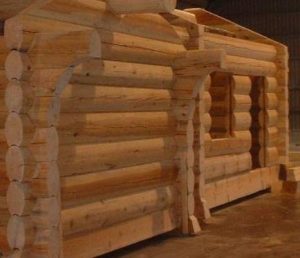
<p>This is a Norwegian log cabin during construction.  The timber used is 'malmfuru' a pine that grows in mountains above an altitude of 1200 metres.  It has similar insulation and structural properties to Cedar or Larch.  This image shows base logs in the order of 300 to 400mm in diameter shaped to provide about 220mm thick external walls at their narrowest.  In order for this to comply with current building regulations, it would need insulation added.  This is a single skin very specialised construction fully assembled in a factory setting prior to being delivered to site.  The timber, being possibly the largest species available in Scandinavia is felled under licence from virgin forests, it is not farmed timber and is typically from trees well over 100 years old.  Due to it being a limited supply this is an expensive timber.</p>
]]></content>
		
					<link rel="replies" type="text/html" href="https://davidmoran.ie/news/2552/#comments" thr:count="0" />
			<link rel="replies" type="application/atom+xml" href="https://davidmoran.ie/news/2552/feed/atom/" thr:count="0" />
			<thr:total>0</thr:total>
			</entry>
		<entry>
		<author>
			<name>David_Moran_Architect</name>
					</author>

		<title type="html"><![CDATA[How to choose an architect.]]></title>
		<link rel="alternate" type="text/html" href="https://davidmoran.ie/uncategorised/hao-to-choose-and-architect/" />

		<id>https://davidmoran.ie/?p=2546</id>
		<updated>2019-06-02T21:13:20Z</updated>
		<published>2019-06-02T20:42:16Z</published>
		<category scheme="https://davidmoran.ie" term="Uncategorised" />
		<summary type="html"><![CDATA[Methods for choosing an architect for a project vary considerably.  Throwing a dart at a map or flicking through the web, phoning the R.I.A.I. (Royal institute of the Architects of Ireland) or by listening the friends who themselves have gone through the process.  All are valid to some degree, but whether you wish for the best experience or the best&#160;<a href="https://davidmoran.ie/uncategorised/hao-to-choose-and-architect/" class="read-more">Continue Reading</a>]]></summary>

					<content type="html" xml:base="https://davidmoran.ie/uncategorised/hao-to-choose-and-architect/"><![CDATA[<p>Methods for choosing an architect for a project vary considerably.  Throwing a dart at a map or flicking through the web, phoning the R.I.A.I. (Royal institute of the Architects of Ireland) or by listening the friends who themselves have gone through the process.  All are valid to some degree, but whether you wish for the best experience or the best result the process should be undertaken carefully.</p>
<p>Signature architects have a particular style while others often do not.  Should a particular style resonate with your requirements and character, choosing a signature architect may be appropriate.   If you are unsure of the style that most suits you, the process is more complex.  Many of the images we see on TV, the internet or in magazines are images that suit the needs and reflect the character of other people.  Choose an architect who matches your needs, who resonates with your requirements or who at the very least listens and applies your wants.  It is our considered opinion that the requirements of architects are always second to those of the client, while applying professional standards and ethics.  Clients are our primary concern.</p>
<p>The list of considerations:</p>
<ul>
<li>What are your requirements? The most complex projects are often domestic in nature.  This is not due to technical complexity, but due to the personal nature of projects and the requirement for carefully considered design.  Many commercial, health care, industrial projects are significantly more complex technically and pose many challenges, homes though require a personal touch and very specific skills.  Compile a list of your requirements, list rooms and each requirement relating to that space, list hobbies and the space needed to provide for interests.  Consider your favourite space in your current home.  The project is about you.</li>
<li>What is your budget? Consider carefully your overall budget.  In discussing this with an architect, be mindful that architects often think in terms of the base budget.  The base budget is the construction cost before other costs or VAT are added.  Express that your budget is your total budget.  It is important to understand the interpretation both you and the architect have of budget.  Allow a contingency, funds that you hope not to use.  This is more important where alterations are being carried out to older buildings, as costs can often not be fully anticipated.  Spend wisely.  Spending large sums without considering options can be wasteful.  The benefits of choosing an architect are far more valuable than the actual cost.</li>
<li>When do you hope to have the project complete? Smaller projects may be relatively quick, larger projects that require planning permission can take much longer.  The fastest project from inception to completion that we have completed in the past ten or so years took seventy days.  From inception to completion, this was a small project.  Some projects can take years.  Architects should advise on a realistic program.</li>
<li>Is an architect necessary? Seeking at least advice on your project may pay dividends.  Many architects work on creating innovative solutions to a wide variety of challenges and may have recommendations that result in savings and in the solution that best suits your needs.  It may be possible to repair a broken car yourself, however, starting the process may result in this taking more time, resulting in a lesser standard of completion and at worst requiring that you procure the services of a good mechanic who then may have to repair the repair prior to fixing the car.  Choosing an expert often results in a satisfactory job that with design offers solutions that enhance the spaces and enhance life experience.</li>
<li>Think of the environment! Some of our clients have very carefully examined technologies relating to energy conservation and ecological concerns.  This is a valuable exercise.  After completing your own research, ask questions about what you have learnt.  Architects have been examining these options for years.  New options are being developed and it is vital that the science behind these options be understood.  Good architects will be familiar with the science of the solution and can advise accordingly.</li>
<li>Choosing an architect is choosing a relationship, it may last years. A relationship where understanding is important which can often extend beyond the project requires a level of familiarity where all parties are comfortable.</li>
</ul>
<p>It is not necessary for you, the client, to design the solution.  This is what architects are trained to do.  Many years are spent in education and training, the minimum in Ireland is seven years (five years in college and at least 2 post graduate internship).  The design and technology are parts only of the process.  There are also legal and planning related considerations.  An architect will advise on the process, the time likely to be incurred and the costs associated.  It is vital that the legalities of the project be complied with.  Any technologies used are subject to and should comply with building regulations.</p>
<p>We make every effort to satisfy the requirements of our clients, the results of which are a wide range of building character solutions that reflect our clients needs.  Our buildings are not designed for us, they are designed for you.  Our processes require that we listen carefully such that our carefully considered design solutions achieve your requirements as fully as possible.</p>
<p>Costs associated with employing architects generally present very good value and are based often on a percentage of the base contract value.  The total costs can be tailored to individual needs.  We do generally advise on what can be achieved but at times advise on adjusting a budget in order to achieve the intention.  Initial consultation costs offer great value, we offer a service providing advice based on requirements where we visit the site or building.  Subject to location, we offer this service at cost, fuel or mileage and seek a contribution to either The Simon Community or Pieta House.  We can discuss this with you prior to providing any service.</p>
<p><img loading="lazy" decoding="async" class="alignnone size-medium wp-image-2547" src="https://davidmoran.ie/wp-content/uploads/2019/06/Vienna-208x300.jpg" alt="" width="208" height="300" srcset="https://davidmoran.ie/wp-content/uploads/2019/06/Vienna-208x300.jpg 208w, https://davidmoran.ie/wp-content/uploads/2019/06/Vienna.jpg 265w" sizes="auto, (max-width: 208px) 100vw, 208px" /> <img loading="lazy" decoding="async" class="alignnone size-medium wp-image-2548" src="https://davidmoran.ie/wp-content/uploads/2019/06/Vienna2-196x300.jpg" alt="" width="196" height="300" srcset="https://davidmoran.ie/wp-content/uploads/2019/06/Vienna2-196x300.jpg 196w, https://davidmoran.ie/wp-content/uploads/2019/06/Vienna2.jpg 306w" sizes="auto, (max-width: 196px) 100vw, 196px" /><br />
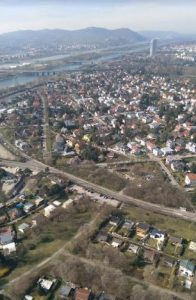
<em>St. Stephens Cathedral and view from the Danube Tower Vienna.  A recent study trip to Vienna examining the ‘Vienna Model’ for housing.  The Vienna Model has recently been studied by Dublin City Council.</em></p>
]]></content>
		
					<link rel="replies" type="text/html" href="https://davidmoran.ie/uncategorised/hao-to-choose-and-architect/#comments" thr:count="0" />
			<link rel="replies" type="application/atom+xml" href="https://davidmoran.ie/uncategorised/hao-to-choose-and-architect/feed/atom/" thr:count="0" />
			<thr:total>0</thr:total>
			</entry>
		<entry>
		<author>
			<name>David_Moran_Architect</name>
					</author>

		<title type="html"><![CDATA[Building responsibility]]></title>
		<link rel="alternate" type="text/html" href="https://davidmoran.ie/news/building-responsibility/" />

		<id>https://davidmoran.ie/?p=2542</id>
		<updated>2019-05-29T21:28:42Z</updated>
		<published>2019-05-29T21:28:42Z</published>
		<category scheme="https://davidmoran.ie" term="News" />
		<summary type="html"><![CDATA[From 2021, all new homes must comply with the nZEB (nearly Zero Energy Buildings) standard as an EU directive.  This means that new homes being then completed must have a BER rating of A1 and at least a very good A2 rating.  To use less than 25 Kw per metre square per annum for space heating will be the requirement&#160;<a href="https://davidmoran.ie/news/building-responsibility/" class="read-more">Continue Reading</a>]]></summary>

					<content type="html" xml:base="https://davidmoran.ie/news/building-responsibility/"><![CDATA[<p>From 2021, all new homes must comply with the nZEB (nearly Zero Energy Buildings) standard as an EU directive.  This means that new homes being then completed must have a BER rating of A1 and at least a very good A2 rating.  To use less than 25 Kw per metre square per annum for space heating will be the requirement for new homes.</p>
<p>This is not optional despite criticism or the seeking of an extension of time on these requirements becoming mandatory.  This standard has been notified for almost ten years.  Sufficient time for the collective consciousness to take stock, particularly for professionals.  However, it also appears that ignorance of this requirements is common.  The RIAI (Royal Institute of the Architects or Ireland) cites in the Code of Professional Conduct under article 1.15 “Whilst an architect’s primary responsibility is to his/her client(s), he/she should nevertheless have due regard to his/her wider responsibility to conserve and enhance the environment.”  Due to this requirement, I do not claim to be an environmental specialist for to be so is a requirement of my profession.  This requires architects to be familiar insofar as is possible with the requirements of legislation generally relating to the environment but also with the science relating to building and the environment.  A detailed knowledge of emerging technologies, both passive and active, used in the built environment that can enhance the natural environment is therefore mandatory.  It at least means that an architect should be familiar with technologies that have the least impact on the environment while realising clients dreams and aspirations.</p>
<p>How we live, travel and work all impact.  Many of my colleagues cycle and use public transport as do I.  I also use private motorised transport.  I admit that I have a passionate interest in machines, but I also realise that I must reduce the amount of energy that I use in both my personal and professional life, as must we all.  In our buildings low energy lights were introduced for the purpose of reducing the energy used.  The results have in studies proven less effective than hoped.  Our grandparents and parents were inclined to turn lights off, turn the emersion off for the purposes of saving energy, or perhaps saving money.  They also spoke about living within our means.  Our means today is too often based on our money.  Notably, our capacity to pay.  Environmental means are less inclined to be considered.  It is not uncommon for lights to be left on, for TVs to be left on, for electrical emersions to be left on and for energy to be wasted.   Hybrid cars are becoming common, many of these are high powered and in fact not very economical.  One of the most economical cars that I ever owned was built in 1968 (NSU Prinz 4, tuned for economy, 60mpg +).  While there are more economical cars today, there are still few on the road.  We simply chose comfort and convenience rather than economy or sustainability.  As we demand more luxury, sustainable developments have less beneficial impact.  We chose to justify this by driving hybrids.  La Ferrari, Lexus RX450h as examples of hybrids are neither economical nor sustainable.  As many have become accustomed to spending a certain amount on fuel or energy, both in our transport and our homes, we are happy to spend this and can extend the use we put to these technologies not despite but because of their improving efficiency.  There can be no significant benefit in doing this for the environment.  Production of sustainable power needs to precede its use.  Any increase in the use of even the most sustainable energy source is easily negated by excessive use.  Data centres and electric vehicles are likely to demand huge amounts of energy.  Rampant use of these technologies will require that we burn fossil fuels.  Energy use needs to reduce.</p>
<p>Our buildings comfort will improve with the best sustainable technologies.  It is vital that we choose actively that this be the case, it is nZEB legislation.  To choose technologies that use 20% of the energy that we have used before while achieving the same result is admirable.  In choosing less together with more sustainability, we can reduce the impact further.</p>
<p>Architect are required to assist in these choices while achieving client’s intentions.  Client’s intentions are the primary goal of architects, but only with careful regard to the environment.  According to the RIAI Code of Conduct, this is not an option.  It is the remit of architects to make the process as effective as possible in every regard.</p>
<p><img loading="lazy" decoding="async" class="size-medium wp-image-2543 alignright" src="https://davidmoran.ie/wp-content/uploads/2019/05/Capture1-300x224.jpg" alt="" width="300" height="224" srcset="https://davidmoran.ie/wp-content/uploads/2019/05/Capture1-300x224.jpg 300w, https://davidmoran.ie/wp-content/uploads/2019/05/Capture1-200x150.jpg 200w, https://davidmoran.ie/wp-content/uploads/2019/05/Capture1.jpg 616w" sizes="auto, (max-width: 300px) 100vw, 300px" /></p>
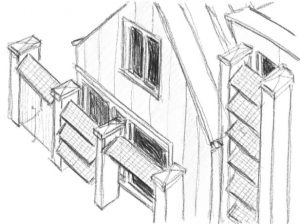
<p><em>The control of unwanted solar gain using solar panels to generate energy in high-efficient modern buildings will reduce operating costs and energy use.  Local and therefore more sustainable sourcing of this technology must also be considered.</em></p>
]]></content>
		
					<link rel="replies" type="text/html" href="https://davidmoran.ie/news/building-responsibility/#comments" thr:count="2" />
			<link rel="replies" type="application/atom+xml" href="https://davidmoran.ie/news/building-responsibility/feed/atom/" thr:count="2" />
			<thr:total>2</thr:total>
			</entry>
		<entry>
		<author>
			<name>David_Moran_Architect</name>
					</author>

		<title type="html"><![CDATA[Building Control]]></title>
		<link rel="alternate" type="text/html" href="https://davidmoran.ie/news/2415/" />

		<id>http://davidmoran.ie/new_website/?p=2415</id>
		<updated>2019-06-02T00:15:17Z</updated>
		<published>2016-04-08T16:51:34Z</published>
		<category scheme="https://davidmoran.ie" term="News" />
		<summary type="html"><![CDATA[There has been much debate relating to the BCMS (Building Control Management System) as recently introduced in legislation. As a result of the apparently onerous nature of these regulations it is being proposed that smaller developments, single houses and domestic extensions be removed from the requirements of these acts. It should be highlighted that the onerous nature of The Building&#160;<a href="https://davidmoran.ie/news/2415/" class="read-more">Continue Reading</a>]]></summary>

					<content type="html" xml:base="https://davidmoran.ie/news/2415/"><![CDATA[<p>There has been much debate relating to the BCMS (Building Control Management System) as recently introduced in legislation. As a result of the apparently onerous nature of these regulations it is being proposed that smaller developments, single houses and domestic extensions be removed from the requirements of these acts. It should be highlighted that the onerous nature of The Building Control (Amendment) Regulations, 2014 relates to the BCMS. The nature of the legislation is that forms need to be compiled ensuring that those involved are suitably qualified and experienced. It has been required that Architects in Ireland are registered in order for services to be provided. This as yet is not the case with relation to building contractors. It is however required that a building contractor undertake in writing to carry out the works in accordance with building regulations. It is good practice to have any building work sufficiently specified to ensure that it is completed in accordance with building regulations, the recent act has not changed this. There has long been a requirement that buildings comply with regulations, and there are long established processes in place to ensure this. The additional requirements in terms of time relate largely to bureaucracy, taking additional time. The significant content of these forms is based on information that should be available even for the smallest projects. Developments that are exempt from planning control are specifically excluded from the BCMS process. They do however remain subject to building regulations.</p>
<p>I have carried out a study using examples of projects and references to various guidelines and legislation highlighting the need for control. While the control measures had been in place on some of these projects, these had at the time not been implemented.</p>
<p>Building Regulations.</p>
<p>For any building to be sustainable in terms of longevity it must be constructed with regard to certain scientific truths. Ireland is a particular climate where the conditions suitable for interstitial condensation may be constant. Water vapour condensing within the structure is common which leads to deterioration conditions developing more quickly in Ireland than in other climates. In timber construction this can be detrimental. The science relating to interstitial condensation is the same the world over and an understanding of it is vital if problems are to be controlled.</p>
<p>The Building Regulations, Technical Guidance documents cite the following:</p>
<p>B.S. 5268 cites B.S. 7543:1992:2003. Superseded by B.S. 7543:2015.</p>
<p>This document categorizes buildings relative to their life span based on intended use.</p>
<p>Table 1. Categories of Design Life for Building.</p>
<p>Cat. Description. Building life. Examples.</p>
<p>1. Temporary. Up to 10 years. Site huts, temporary exhibition.</p>
<p>2. Short life. Minimum 10 yrs. Temporary class rooms.</p>
<p>Buildings for temporary use, industrial.</p>
<p>Retail and warehouse.</p>
<p>3. Medium life. Minimum 30 yrs. Most industrial buildings, house</p>
<p>refurbishment.</p>
<p>4. Normal life. Minimum 60 yrs. New health and education.</p>
<p>New housing and high quality refurbishment of public buildings.</p>
<p>5. Long life. Minimum 120 yrs. Civic and other high quality buildings.</p>
<p>Table 2. Categories of Design Life for Components or Assemblies.</p>
<p>1. Replacement.</p>
<p>Shorter than building life where replacements can be envisioned at design stage.</p>
<p>2. Maintainable.</p>
<p>Will last with periodic treatment for the life of the building. Example: External</p>
<p>cladding.</p>
<p>3. Lifelong.</p>
<p>Last for the life of the building. Examples: Foundation and structure.</p>
<p>It is therefore clear that conditions within any structure are sustainable to the extents noted above. While the Technical Guidance Documents are Guidance only, the intention of these is that the buildings comply with the Regulations. The Regulations are those highlighted within the Documents in grey boxes. The guidance demonstrates common means by which these regulations may be achieved. Where there is a technical variation to these guidelines it should be possible to demonstrate compliance by reference to other standards. The building control relied on since the introduction of these regulations, (the ceasing in effect of the council bye law system) was the duty of the professionals and contractors involved. It appears that the failing of the system was that there was no clear requirement of clients to employ suitably qualified professionals. This resulted in a condition whereby anyone could provide construction and design related services, this remains the case where building contractors are concerned, it is no longer the case where architects are concerned. The use of the term ‘architect’ is controlled in legislation.</p>
<p>Any significant increase in costs consequent on the BCMS system is therefore more the result of a failing in the superseded system than it is in the new system. Where projects previously had been carried out correctly with sufficient specification and inspections by suitably qualified professionals the costs would largely be similar to today, and the projects would likely be successful. The additional costs incurred in the current system would therefore be confined to the preparation of documents and submissions to the authority. These are based on information that should be available for the development of any project subject to building regulations, this includes projects that are exempt from planning control. In my experience, this amounts to approximately 5 days work at most. While this does add cost, it is not significant in relation to the full services that should be provided in any event. The significance as noted relates to these services not having been fully provided for prior to the 2014 act.</p>
<p>Building Control and Building Regulations are distinct from one another. The need for building control applies to anything in the built environment. The need for Building Regulations arises in order to ensure Building Control by placing a legal responsibility on all those involved in the building process, including clients.</p>
<p>Timber construction.</p>
<p>Timber frame construction is subject to extensive damage consequent on the absence of correct detailing, construction and expertise. There is a contention in Ireland that timber construction is relatively new and therefore that expertise is limited. This is no more true in Ireland than in any other country, even countries where timber construction is a long standing tradition. I have inspected timber frame houses in Ireland built in the 1970s which were correctly detailed and constructed, the expertise was clearly available forty years ago. The absence of expertise being applied is a product of a combination of factors. Lack of proper education, lack of care and an assumption that to employ suitable experts as an unnecessary cost all contribute to problems. Education relates to the need of clients to understand that the experts offer a valuable resource, it also relates to CPD (Continual Professional Development) being practiced by those experts. The R.I.A.I. is the appointed governing body of architects in Ireland, any architect registered (whether a member or not) is subject to the Code of Professional Conduct. With relation to the Code of Professional Conduct, this applies under Section 6 of The Building Control Act, 2007. All registered architects whether members or the R.I.A.I. or not are subject to this Code. This is not the case with Building Contractors, though it is proposed. Does this place a higher responsibility on registered professionals? I recently interviewed principals of construction companies. The proportion who understood interstitial condensation was of concern. It was considerably less than 50%. When presented with details Fig. 1 and Fig. 2 many were unable to comment on the interstitial condensation risk. One who had been educated in the country where timber construction is traditional and who had a college education in construction technology and management was amongst those unable to comment. The requirement for CPD is a condition of members of the CIOB relating to the building industry. The CIRI, an official registration body noted as being supported by government has prepared a Code of Conduct which requires members to be sufficiently informed or to employ sufficiently informed persons to provide services. Membership of the CIRI is increasing and there is mandatory CPD requirements for members. It is as yet not an appointed body under any building control regulation.</p>
<p><img loading="lazy" decoding="async" class="alignnone size-medium wp-image-2417" src="http://davidmoran.ie/wp-content/uploads/2016/04/Fig-1-300x175-300x175.jpg" alt="Fig-1-300x175" width="300" height="175" /><br />
Fig 1</p>
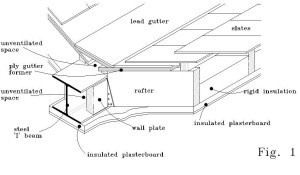
<p>Fig. 1 shows a condition on site where a steel ‘I’ beam was supporting rafters along the line of a slopping valley gutter. There is positioned internally to the beam and the rafters insulated plasterboard with an integral vapour barrier. The wall plate to which the rafters are fixed effectively creates an unventilated space in a location where due to the cold bridging effect of the steel beam is highly likely to develop interstitial condensation. In this case I believe it is highly likely that the wall plate will over time rot, seriously weakening the roof structure.</p>
<p><img loading="lazy" decoding="async" class="alignnone size-medium wp-image-2418" src="http://davidmoran.ie/wp-content/uploads/2016/04/Fig-2-300x164-300x164.jpg" alt="Fig-2-300x164" width="300" height="164" /></p>
<p>Fig 2</p>
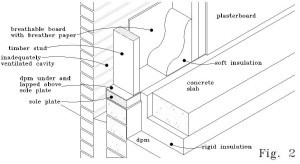
<p>Fig. 2 shows a condition inspected where the external blockwork / brickwork is not been fitted with adequate drainage or ventilation. This is a common condition where the required cavity is provided with less ventilation than needed, or in cases not provided with any ventilation. This will lead to the deterioration of the timber structure.</p>
<p>This highlights the difference between building regulations and actual building control. The majority of building control is carried out on building sites and it is therefore fundament that those operating and in particular managing building sites are sufficiently informed about the technology being employed. Fig. 1 and 2 are illustrations of conditions where interstitial condensation is likely to cause problems. Fig 2 on inspecting buildings throughout Ireland has been a common error over a number of years.</p>
<p><img loading="lazy" decoding="async" class="alignnone size-medium wp-image-2419" src="http://davidmoran.ie/wp-content/uploads/2016/04/Fig-3-300x174-300x174.jpg" alt="Fig-3-300x174" width="300" height="174" /></p>
<p>Fig 3</p>
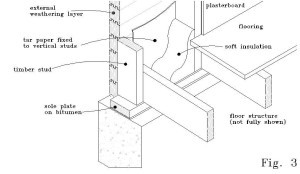
<p>Fig.3 shows a condition inspected where the external finish has been fixed to the timber structure with a separating layer of tar paper. As with other examples the insulation used is soft fibreglass with is subject to settlement. The base plate is fitted onto a masonry wall separated using bitumen. Note: the base plate is fitted centred on the masonry wall limiting sufficient drainage of the weathering layer. In addition to the absence of any interstitial moisture control, there is a risk of ponding adjacent to the sole plate. In this example the structure was seen to be severely deteriorated.</p>
<p>Fig. 3 is a more serious detail where inspections have revealed serious problems arising out of both penetrating moisture and interstitial condensation. This is a problem that is repeated throughout Europe. Ireland has a climate where interstitial condensation can be a daily issue throughout the entire year and is likely to develop problems associated with Serpula Lacrymans (common dry rot) or Coniophora Puteana (common wet rot). Dry rot develops in slightly damp unventilated spaces, these are generally not the result of penetrating damp, leaks of heavy rain. Dry rot develops in conditions more similar to interstitial condensation where the moisture content is lower and there is inadequate ventilation. It spreads more rapidly and due to being in unventilated spaces not subject to high levels of moisture it also spreads invisibly. Wet rot develops in higher moisture content areas, often penetrating damp (rain water and leaks) the bottom of drained cavities when blocked, and is often very damp or wet to the touch. The base of timber stud walls, to where interstitial condensation had drained if not drained clear of the building yields both types of rot depending on the specific conditions. Dry rot may be more inclined to develop in less damp areas. Ventilation is the primary control of dry rot while preventing moisture ingress or high levels of moisture being retained in the structure is the primary prevention of wet rot. There are of course solutions that may be applied for the control of both. This does not alleviate the need for correct preventative detailing. Fig. 3 shows a detail of a wall, with no ventilation gap between different components of timber construction. Fig. 2 shows an image where there is a gap but it is not ventilated. Both these conditions provide instances where interstitial condensation builds up at the junction of the components or in the gap. There is no means to dispel the moisture content through either evaporation or drainage in both cases and the conditions for the development of rot is therefore ever present. Ireland as noted having conditions suitable year round for interstitial condensation is likely to develop these problems earlier than countries with clearly defined seasons. These detrimental conditions however are not limited to Ireland, this is reflected in standard details for the control of such problems in countries including Canada, Finland, Sweden, Germany and of course Ireland. This is reflected in legislation related documents and published production details that are easily available.</p>
<p>The absence of proper building control over the past 20 years in Ireland (not exclusively) has resulted in there being many instances of the above conditions. For houses built up to 15 years ago with correct maintenance these are only now beginning to show signs of deterioration. Timber frame suppliers often provided the frames to contractors who completed buildings particularly in speculative developments without using suitably qualified professionals. The costs associated at the time with these professional services were seen by many to be unnecessary. The timber frame suppliers had at times been timber suppliers or saw mills who in cases I have seen developed systems again in the absence of suitably qualified professionals. Some of these systems were primarily supplied to one off projects, some were supplied to speculative developers. The absence of ventilation is possibly the most common of faults, inadequate protection of base or sole plates is another common fault. Another repeated fault is where ventilation has been blocked by owners or occupiers in the belief that the provided holes result in lost heat. This is due to an absence of instruction to end users when the building is complete. This in the form of a safety file is now common practice but has not been in the past, especially relating to one off housing. Heat loss is another common factor that disappoints end users who believed that timber frame houses are inherently better insulated. Using soft insulation as was very common some years ago in vertical spaces results in settlement and the appearance of insulation gaps or pockets within the structure, this further aggravates the possibilities of interstitial condensation especially where other factors are supportive of its incidence.</p>
<p>Conclusion.</p>
<p>Any assertion that the introduction of the BCMS process is adding extensive and unsustainable costs to the construction of smaller one off houses or extensions is in my opinion unwarranted. In fact, the process whether formalised legislatively or not should be applied to all buildings subject to building regulations. The absence of suitable control in the past has yielded expensive mistakes that could and should have been avoided. The bureaucracy associated is onerous, is in cases followed through by local authorities in the best interest of the end users, with inspections. The costs associated are of little consequence when associated with the services that should be provided. These costs are of no consequence when compared with the suffering caused by poor detailing, poor execution and the high cost of remedial work. Priory Hall is a highly public example of the absence of proper detailing and inspections by suitably qualified persons. While not being familiar with the full details, at the time this building was constructed it was common practice for developers to complete developments based on little more than planning drawings. These are not suitable for technical detailed work and would not be accepted under the current system. Nor should this scant level of detail ever have been accepted for any development. To accept less for a one off house or extension, (these often being amongst the largest financial undertakings by home owners) is negligent. To seek that control measures be removed from the process of smaller developments in the interest of fiscal savings is madness.</p>
<p>Other failings in the built environment relating to Radon gas, fire control and sewage treatment have been linked to deaths. The CIRI requires that it’s members be suitably experienced and informed in relation to detailing and construction. This requirement implies that other professionals be able rely on the contractors expertise. This does not alleviate the requirements of those professional responsibilities. The ever increasing specialisation means that expertise must be reliable.</p>
<p>Bibliography.</p>
<p>The Building Control Act, 1990. Number 3 of 1990.</p>
<p>The Building Control Act, 2007. Number 21 of 2007.</p>
<p>The Building Control (Amendment) Regulations, 2014. S.I. No. 9 of 2014.</p>
<p>B.S. 5268 cites B.S. 7543:1992:2003. Superseded by B.S. 7543:2015.</p>
<p>The National Building Code of Finland. Section C2.</p>
<p>https://dspace.cc.tut.fi/dpub/bitstream/handle/123456789/188/vinha.pdf?sequence=1</p>
<p>Fig 1.1 shows typical sections through Finnish one family and row houses</p>
<p>Fig 1.1 shows typical sections through Finnish one family and row houses<br />
http://www.stkloghomes.com/resources/public/asennusohjeet//Design_principles_STK_eng.pdf</p>
<p>Section 4;3 Moisture behaviour of log walls.</p>
<p>Section 4.4</p>
<p>4.4 Moisture proofing</p>
<p>1. Hirsitalojen toimitusehdot (‘Terms and conditions of delivery for log buildings’). Finnish Loghouse Industry Association (HTT), 3/2001.</p>
<p>2. Design principles for log buildings. Finnish Loghouse Industry Association (HTT), 3/2001.</p>
<p>3. Quality requirements for log buildings.</p>
<p>Finnish Loghouse Industry Association (HTT), 3/2001.</p>
<p>The HTT has also published two books:</p>
<p>1. Hirsitalojen suunnittelu (‘Design of log buildings’). Rakentajain Tietokirjat 3/2001</p>
<p>2. Hirsitalon rakentaminen (‘Building a loghouse’). Rakentajain Tietokirjat 3/2001<br />
http://www.slideshare.net/RDHBuildings/woodworks-2013-energy-efficient-building-enclosure-design-guide</p>
<p>Homebond, House Building Manual. 3rd Edition. 2001 Eugene Farrell, John A. McCarthy. Anthony McFeely.</p>
<p>Husets ABC. 2003. (Sweden). Per Hemgren &amp; Henrik Wannfors.</p>
<p>Building Regulations Part. Technical Guidance Documents, Part L. 2002.</p>
<p>Construction Industry Register Ireland. CIRI Policy on Continuing Professional Development.</p>
]]></content>
		
			</entry>
		<entry>
		<author>
			<name>David_Moran_Architect</name>
					</author>

		<title type="html"><![CDATA[Guide to Project Management responsibilities]]></title>
		<link rel="alternate" type="text/html" href="https://davidmoran.ie/news/guide-to-project-management-responsibilities/" />

		<id>http://davidmoran.ie/new_website/?p=2411</id>
		<updated>2018-09-26T00:02:05Z</updated>
		<published>2016-04-03T16:50:02Z</published>
		<category scheme="https://davidmoran.ie" term="News" />
		<summary type="html"><![CDATA[The process. Fifteen tests with fifteen possible results, or diagnoses. Anything other than what is anticipated and the system stops. There are two outcomes to the system stopping, one is that a new or revised system is adopted, the other is that it simply stops and there is no outcome. Which of the above relates to a project where the&#160;<a href="https://davidmoran.ie/news/guide-to-project-management-responsibilities/" class="read-more">Continue Reading</a>]]></summary>

					<content type="html" xml:base="https://davidmoran.ie/news/guide-to-project-management-responsibilities/"><![CDATA[<p>The process.</p>
<p>Fifteen tests with fifteen possible results, or diagnoses.  Anything other than what is anticipated and the system stops.  There are two outcomes to the system stopping, one is that a new or revised system is adopted, the other is that it simply stops and there is no outcome.  Which of the above relates to a project where the system is the purpose?  Which relates to an outcome!  Any project management system is nothing more than a tool to assist in achieving a desired outcome.  Take an example of a health care system.  The purpose is to promote health and healing.  Where illness is apparent, the purpose is to find a cure.  Fifteen tests with fifteen diagnoses.  This relates obviously to a very simple and possibly standardized range of outcomes.  The standardization of any system of this kind is clearly based on statistics.  In carrying out tests for the conditions most likely it is possible to establish the illness quickly.  If all fifteen tests yield no diagnosis, they will then proceed to the next system, a system other than the one normally practiced, a contingency or something entirely new.  This then requires a combination of expertise, imagination, innovation, openness and intelligence.  The patient is referred to a consultant expert.  Common obstacles or supports to any system relate to belief.  Not only a belief in the system, but a belief in the outcome,<br />
and perhaps more particularly, that the outcome is possible.  A belief that the fifteen tests have failed in arriving at a diagnosis is an obstacle or a limiting belief.  A belief that the fifteen tests have eliminated possibilities is a success.  A blind faith in the infallibility of a system leads at times to a false protection of refusing to be seen to fail.  No one likes sharing failure, and if the belief is that the fifteen tests have failed then the sharing of results is at times refused.  Where the belief is that these tests have successfully eliminated possibilities then the sharing of this information will prevent duplication.  Duplication is the adding of unnecessary weight and uselessly expending energy.  Duplication or any adding of tests that are not required costs time and money.</p>
<p>‘I have not failed, I’ve just found 10,000 ways that won’t work’.  (Thomas Eddison)</p>
<p>Thomas Eddison of course references 10,000 different ways, and not of one way disproven 10,000 times.</p>
<p>Project management systems are the formalizing of thought processes.  The emphasis being on thought where the formulas are mere tools.  Should I travel back in time with a modern car, say to the middle ages, people would see the car operating without any apparent external power.  Apart from the risk to me of being burnt as a witch, this simple demonstration would highlight to those a possibility.  Assuming that no detailed inspection is allowed how long after this would a modern car become possible?  It would simply happen because it is possible.  However, while it may do everything a modern car can do, it may in terms of the system used be very different.  This would be the result of expertise (that available at the time), imagination (considering with that expertise how something may be possible), innovation (invention), openness (unwilling to apportion the possibilities to witchcraft) and intelligence.  All these factors must therefore be applied when an existing system does not deliver a genuine possibility.  Thought is vital even when applying an established system.  To blindly go where no one has gone before, is to apply an established system to a new challenge.  It may work, but without thought it is not likely to.  Essentially, it is never wise to ignore possibilities due to establishment practices.  The fifteen tests noted are merely a representation of a system.  All systems in order to have some level of success require rigidity.  But!  All systems in order to excel must be flexible.  For simple or non complex goals, systems work.  For complex goals, a series of systems may be required, though more importantly innovation and intelligence is needed.</p>
<p>Impediments and solutions to progress.</p>
<p>Science may be likened to religion, where adherence to a principal is dogmatic.  The science of project management may therefore at times be a dogmatic adherence to a system or systems.  The demonstration of achieving a goal that has proven impossible when dogmatically applying a system at times can generate a feeling of impotence in those applying the system.  This is threatening, it threatens the ego as did anything unusual in medieval times threaten the status of established religion at the time.  Fires burned.  Fear is another major impediment to achieving goals.  The fear of trying something new, the fear of being vilified for trying something new, the fear of being sued for trying something new, the fear of failure.  If the fear of failure prevents one from trying….</p>
<p>‘Get rid of the fecking eejit barrier’.  (Paul Ronan)</p>
<p>A patient visits a doctor.  The doctor carries out a thorough examination with the limitations of equipment and general practice.  While it is evident that there is something wrong, it is not possible with the GP system to establish a diagnosis.  The doctor refers the patient to an expert and shares the FULL information gathered with that expert.  (This it appears does not always happen).  It’s like a relay race, the expert carries forward the gathered information in order to seek a diagnosis.  This process continues, to other experts, to stations where highly technical scanners and equipment are used, the information gathered increases and the likelihood of a diagnosis.  Any system or series of systems may be exhausted.  This is not the failings of the individuals or experts within the system or the system itself.  It is in fact the success of that system in eliminating possibilities.  The remaining possibilities in each process are lessened, their number declines.  Belief is a highly important aspect of achieving any goal.</p>
<p>‘Whether you think you can, or think you can’t, you’re probably right’.  (Henry Ford)</p>
<p>What if that fifteen stage process could be reduced to five?  Is this because the ten are superfluous to the desired outcome?  Fifteen cogs in the machine, take for instance a construction project.  In a construction project, there is a client, architect, engineer and contractor.  There may also be services engineers, quantity surveyors, project managers and others.  The need for each should be evaluated and anything superfluous should not be engaged with.  Political interests, greed and the will to control are all aspects that lead to added cogs which will at best reduce the efficiency of the overall process.  The primary interest must always be the end goal.  At worst, the projects can be stopped completely.  Evaluate the project based on complexity and size, reduce the number of cogs to the absolute minimum and then add only those that will make the process smoother.</p>
<p>“In our glorious fight for civil rights, we must guard against being fooled by false slogans, as ‘right to-work.’ It provides no ‘rights’ and no ‘works.’ Its purpose is to destroy labor unions and the freedom of collective bargaining… We demand this fraud be stopped.”                   (Martin Luther King Jr.)<br />
The illusion of protecting the ‘right to work’ in instances where additional cogs are added for the mere purpose of providing ‘jobs’, whether for friends, family or the dispossessed is not the protection of any ‘rights’.  It is in fact the neglecting of the ‘rights’ of the end users in any project.  Any failure in the building of for instance a hospital due to adding needless cogs results in a delay in the treatment of illness and death for some of the end users.  This is an almighty failure.  A broken cog will fail in delivering the power to the end purpose, when broken cogs are realized the simplest and quickest solution is to remove them.  This in no manner means that to employ is not correct, it merely states that in order to employ correctly, those employed must be supportive of the project.  To qualify this further, to employ in this regard is to add cogs of any kind.  Unfortunately, larger civic projects often have many cogs.  These are added for a variety of reasons, much of which does not support the end goal.  An example may be political interference in the proposed location of a hospital.</p>
<p>Rear elev</p>
<p>Ghosts in the machine.<br />
Examples of weak cogs based on my own experience include invisible or concealed cogs.  Inattention results in the expectation that others will perform and take in the slack, this is laziness.  Ego is where individuals believe themselves capable of everything.  I have encountered many examples of this and it relates to a pathological need to control and is more often carried out by those without ability than those with.  There is at times a focus on the image as being the all important, the perception others have of the egotist.  Those who have educated themselves sufficiently to carry out tasks often realize their inability to do everything.  Greed blinds people to the greater good through the focus being so narrow.  Lack of trust, again this relates to ego in that those who fail in trusting their appointed experts do so out of ignorance and a misguided self belief.  All of these are invisible cogs in a machine and can sap the progress or energy completely.  Even where the ultimate goal is achieved it is often less than is could have been.</p>
<p>Having unrealistic expectations relating to possibilities, costs or program are other examples of additional cogs that prevent growth or progress.  These expectations often result in projects being re-evaluated, a time consuming and expensive process.  It is a client’s responsibility to appoint expertise that they can rely on, that they trust.  It is a following necessity that they listen to and pay attention to those experts.  This is not only a progress related duty, it is in fact a legal responsibility relating in Ireland to building control and health and safety regulations.  Additional measures are sometimes needed. Where the system and process is already successful, additional cogs should carefully be evaluated.  This is a client’s responsibility based on the advice given by those appointed experts.  Remember, these appointed experts are often well educated in their chosen specialist areas and are therefore likely to be familiar with their own limitations.  It is of course the responsibility of the experts to admit their own limitations, both to themselves and to those they represent.</p>
<p>Procrastination can be a major impediment to progress in many respects.  I will avoid the reference here to the failure in making decisions.  In order to avoid procrastination be aware of the alternatives available where there is a possibility of a particular process not being successful.  If you’re driving up a steep hill and the second gear cog shears, the faster you change to first in order to maintain progress the less likely you’ll come to a complete stop.  If you procrastinate and fail in changing quickly enough the vehicle will come to a complete stop.  Avoiding procrastination is about speed.  Procrastination also relates in project management to attitudes, an experts opinion may at times be at variance with their clients.  Where the client has been sufficiently informed an expert without very good reason should not insist on a particular technology.  Insisting on something already decided on creates delays and additional costs.  Make decisions quickly based on full information and progress.  Avoid revisiting decisions already made.</p>
<p>Corruption generally increases the costs of a project both in terms of time and money.  At its most basic form, corruption can arise by placing the wants of an individual above those of a collective.  This can be done subconsciously where the need for simplicity is seen as taking the first option when it may be true that another option would serve the project better.  By definition it relates to the corrupting of a project.  This can be as simple as arguing about a technology or adding an additional unnecessary cog.  Corruption may of course be deliberate, that’s for another time.<br />
Conclusion.</p>
<p>A client’s responsibility to appoint suitably qualified and able people to carry out tasks needs to be accompanied by trust.  Is it the responsibility of a client to double check their agents ability, or can they merely base it on trust?  This is the reason for organizations and legislation attesting to individual’s ability, it may well be considered the clients responsibility to check suitable registers.</p>
<p>The agents or experts responsibility is to their clients and the processes needed to achieve a desired outcome.  There is a strong emphasis on the honesty of making claims to actual abilities.</p>
<p>Focus and attention of all involved is of paramount importance in achieving anything.  The more complex the intention, the more flexible the process must be.</p>
<p>Who owns the project?  Who manages the initial control of a project?<br />
It is the initiator of the project who carries the responsibility.  It is also often the initiator who requires most the abilities of those experts appointed in order to comply with that responsibility.</p>
<p>Bibliography.</p>
<p>http://www.irishtimes.com/news/world/europe/berlin-letter-myth-of-efficiency-tarnished-by-spiralling-costs-1.2307833</p>
<p>http://www.sciencedirect.com/science/article/pii/S026378630300070X</p>
<p>http://amj.aom.org/content/49/1/9.short</p>
<p>http://www.sciencedirect.com/science/article/pii/S0140673604169870</p>
<p>https://books.google.ie/books?hl=en&lr=&id=Nuud0a1VVxwC&oi=fnd&pg=PR7&dq=management+system+failures&ots=uj0ifgHaIO&sig=v8IWIDeZwy2HOXhwASsh5hsN1Zk&redir_esc=y#v=onepage&q=management%20system%20failures&f=false</p>
]]></content>
		
			</entry>
		<entry>
		<author>
			<name>David_Moran_Architect</name>
					</author>

		<title type="html"><![CDATA[Building costs.]]></title>
		<link rel="alternate" type="text/html" href="https://davidmoran.ie/news/building-costs/" />

		<id>http://davidmoran.ie/new_website/?p=2409</id>
		<updated>2018-09-26T00:02:05Z</updated>
		<published>2016-03-26T17:49:22Z</published>
		<category scheme="https://davidmoran.ie" term="News" />
		<summary type="html"><![CDATA[We are emerging it appears from a fiscally dull period and into a new era. We hope! The time when providing favours to those seeking work has in Dublin at least passed. By this I mean attitudes that I’ve witnessed in people who apparently expect services or works to be carried out below cost as if to pay was charitable.&#160;<a href="https://davidmoran.ie/news/building-costs/" class="read-more">Continue Reading</a>]]></summary>

					<content type="html" xml:base="https://davidmoran.ie/news/building-costs/"><![CDATA[<p>We are emerging it appears from a fiscally dull period and into a new era.  We hope!  The time when providing favours to those seeking work has in Dublin at least passed.  By this I mean attitudes that I’ve witnessed in people who apparently expect services or works to be carried out below cost as if to pay was charitable.  There is also a prevalent opinion that works are as a result of the recession more affordable.  The cost of materials continues and has continued to rise and the cost of labour is now following suit.</p>
<p>Recently, a colleague informed me of his difficulties in procuring viable projects.  He had in the past two years completed a modest extension which included alterations to a semi-detached house.  His clients had established a budget without consulting a professional and had established what was ‘possible’.  I can only surmise that the evidence on which this budget was based was pub conversation and word of mouth.  In reality it appeared highly unrealistic.  Their budget was very low and their expectations very high.  My expert colleague managed their expectations very well, to a point.  For the tender stage the clients selected a contractor who was included and it transpired that his tender was the most economical.  The margin was of concern to my colleague and he expressed this to the client.  As protocol dictates, he asked the contractor if he would stand over his tender.  The contractor duly complied, even after it had been suggested that the margin was extensive.  A contract was entered into during the course of which it become increasingly evident that the contractor was struggling to complete the works within his tender.  In fact, my colleague estimated the project to have cost the contractor.  The clients in their wisdom had removed certain aspects from the contract in an attempt to affect savings.  The kitchen was supplied and fitted by the client, the flooring, decoration, site completions, tiling, and other small items were all removed from the contract, thus having a more detrimental effect on the contractor.  My colleague believes that the contractor has since emigrated.</p>
<p>This is a typical scenario.  But also typical is a reluctance of people to admit their actual expenditure.  A more interesting aspect to this story is the client’s subsequent claims to their friends (probably in the pub) that the costs of the project were low.  In fact, the costs that they claimed were lower than the contract sum, though they claimed to have completed all the works, including the kitchen, the flooring, decoration, site completions, tiling, and other small items, below the actual contract sum.  This was a blatant attempt to appear to have spent less money, possibly with the intention of highlighting that they didn’t have money to spend.  Whatever the reason, the effect is that they managed the expectations of others, who then, like they had, established what was ‘possible’.</p>
<p>This reality has a more sinister effect.  For it may be possible to have works carried out for the low costs noted.  I personally have witness over the years of providing a professional service evidence of these savings.  I’ll restate that it is possible to have works carried out for the low costs rumoured, this is due to the effects of pressure for that ‘possible’ and for the willingness of certain ‘handy men’ to exploit these rumours.  Mild things like spiders being painted over, painting with no preparation are common.  Less obvious are works relating to foundations, floor structure, plumbing and electrical installations.  I inspected a house where there had been added electrical sockets in a kitchen, linked to the cooker feed.  Should appliances fail, or the sockets themselves become faulty (one was located beside the kitchen sink) the circuit to which they were connected was rated as 32 amps, far higher than the required cut off for the sockets.  This could have resulted in fire.  I have also seen live wires, still connected and thrown above ceilings to be forgotten, a serious fire hazard in an area filled with kindling.  Boilers with no ventilation, unsealed gas units, cheap and rotten chipboard floors on undersized joists, replaced pipes covered, not having been replaced at all.</p>
<p>Who of us would have a general handyman fit new brakes to our cars, in the mere interest of saving money, or saving face.  ‘Look I got these brakes fitted for nothing!’. Just before driving into a river.  Who of us would even consider this, yet each day people take risks paying people less.  When I go to a doctor, I expect a doctor.  For my car I expect a mechanic.  For my house I would do nothing to risk life, we spend so much of our time at home, we rely on the carbon efficiency of our heating devices, the reliability of our electrics and the comfort of our home.</p>
<p>The only way to manage the expectations of anyone is to tell the truth.  It is better not to begin something than to begin ill prepared.  I wouldn’t begin a long journey across a desert with half the fuel that I needed.</p>
]]></content>
		
			</entry>
		<entry>
		<author>
			<name>David_Moran_Architect</name>
					</author>

		<title type="html"><![CDATA[Water charges and use.]]></title>
		<link rel="alternate" type="text/html" href="https://davidmoran.ie/news/water-charges-and-use/" />

		<id>http://davidmoran.ie/new_website/?p=2405</id>
		<updated>2018-09-26T00:02:05Z</updated>
		<published>2016-03-24T17:48:20Z</published>
		<category scheme="https://davidmoran.ie" term="News" />
		<summary type="html"><![CDATA[The average Irish adult uses about 150 litres of water per day at home. http://www.progressio.ie/water/water-in-ireland/ 150 litres per person equals about 600 litres for a household of four persons, or about 220,000 litres each year. Ok, that’s average! What can we do? As architects we can ensure that new developments or renovations use taps and toilets that use less, that&#160;<a href="https://davidmoran.ie/news/water-charges-and-use/" class="read-more">Continue Reading</a>]]></summary>

					<content type="html" xml:base="https://davidmoran.ie/news/water-charges-and-use/"><![CDATA[<p>The average Irish adult uses about 150 litres of water per day at home.</p>
<p>http://www.progressio.ie/water/water-in-ireland/</p>
<p>150 litres per person equals about 600 litres for a household of four persons, or about 220,000 litres each year.  Ok, that’s average!  What can we do?  As architects we can ensure that new developments or renovations use taps and toilets that use less, that we harvest any water that we can for re-use in gardening or external washing and for the flushing of toilets.  If the average efficient toilet flush uses 8 litres, and we each flush the toilet about 5 times a day, that’s 40 litres if the toilet is modern and efficient. For four people that’s nearly 60,000 litres each year.  All the other uses, washing ourselves, clothes and dishes, washing the car, the patio, the windows and the dog use water too!  If we washed the patio, the car, watered the garden and flushed the toilet with recycled or harvested water we could significantly reduce our net water consumption.  Dishwashers use about half the water that is used by washing dishes by hand.  Where renewable energy from sustainable sources is used, then using a dishwasher is more environmentally viable.  In essence we could easily half our consumption with little change to our life style.  Add to this the question, is our life style sustainable?  Perhaps we should examine our life styles in order to ascertain whether savings could be made with small alterations.<br />
Estuary<br />
Water charges are proposed in Ireland and are roughly based on the average adult use.  The proposed domestic allowance is slightly in excess of this.  It is not clear as yet whether the allowance will be the amount of water that is proposed to be used within the standing charge.  As the standing charge is however cited as being for the provision of water metering services and maintenance of the system it appears that the standing charge may not include any amount of water.  This is reflected in the low annual standing charge of €240.  It has been reported that the annual real costs could average €560 per household.  Whether this cost is passed on to customers directly or through other ‘taxes’ has no bearing on it being a real cost.  Removing the standing charge results in a cost per litre of 0.15 of one cent.</p>
<p>http://www.irishtimes.com/business/sectors/retail-and-services/one-way-or-another-you-will-pay-for-running-irish-water-1.1791345</p>
<p>If we reduce our consumption by half at home we can theoretically reduce the cost by about one third, or €165 per annum.  Do we need more incentive?  Yes!  Using more water away from home is definitely going to cost us more, added to which any unnatural increase in water use away from home is likely to yield an increase in general services costs.  The gym will get more expensive.</p>
<p>However, the imagined incentive is to use less water rather than alter our lives to be more efficient.  This may well lead to some of us neglecting the more important things in life, like drinking water and being clean.  The real rewards should perhaps be applied to those who implement measures to save water such as using low capacity toilet cisterns, low use taps, rain water and waste water harvesting.  A possible incentive is to have a low standing charge that includes the use of an efficient water use relative to the size of house.  This would make it possible for people to live with the standing charge.  In large cities the treatment of waste water for human use is common with their often being no other option.  The concern is not the final quality, treatment in the developed world for this waste water is excellent.  The concern is the cost and the need to improve the capacity to produce high quality water.  Overtaxing these systems with surface water or wasted fresh water incurs greater cost.  Efficient separation of drainage systems needs then to be established everywhere and enforced.  There is little effect in proposing that all new development have separate drainage systems without implementing these systems in the public areas.  There remain large areas predominantly of high density where separate systems do not exist other than in private developments.  This separation is then cancelled once in the public domain thereby taxing the treatment systems unnecessarily.</p>
<p>Why save water?  In Ireland in rains, there is plenty of water!  The truth is that this water is not treated and not fit for human consumption.  Of more concern is the depletion of the aquifers in Ireland.  Despite the apparent increase in rainfall, the aquifers in Ireland and throughout Europe and the developed world are in danger of continuing to deplete.  The very essence of our land is drying out, withering below us.  This is invisible and difficulty to imagine when floods increase.  The consequences of our continuing disregard includes in the short term ever rising services costs, but in the long term may be far more serious.  These aquifers are our source of naturally treated water, filtered through ground systems over many years.  The water cycle relies on natural surface water permeating back to the aquifers below.  Prior to treatment, waste water has high levels of various toxins, chemicals from washing, detergents, oils and so on.  These may well contaminate future aquifers.  This is an important reason why foul drains should never mix with surface water drains.  Add this contamination to low levels in aquifers and the proportionate contamination is higher.</p>
<p>In the developed world we can easily reduce our water use by as much as 75%, this would based on the current proposal in Ireland yield a saving in financial terms only of approximately 44%.  A lot of effort for apparently little return!  The world despite the impression that we are given is only in small part financial.  It would be fair to reflect the truth and afford a consequential and equitable reward in terms of finance to those practicing restraint.  Were the cost of this restraint alone credited to those diligent more will be achieved.  Revenue is needed to repair and upgrade the public systems.  Increasing the capacity of the treatment systems to cater to the actual demand (including surface water) without trying to reduce that demand does incur additional costs.  The solution requires the cooperation of the people and the authorities in their combined attempts to address the problem.  We should cooperate both with use constraints and effluent control.  Our future is important!</p>
]]></content>
		
			</entry>
		<entry>
		<author>
			<name>David_Moran_Architect</name>
					</author>

		<title type="html"><![CDATA[Low energy building.]]></title>
		<link rel="alternate" type="text/html" href="https://davidmoran.ie/news/low-energy-building/" />

		<id>http://davidmoran.ie/new_website/?p=2403</id>
		<updated>2018-09-26T00:02:05Z</updated>
		<published>2016-03-23T17:47:51Z</published>
		<category scheme="https://davidmoran.ie" term="News" />
		<summary type="html"><![CDATA[Low Energy house record of temperatures. Attached is a temperature chart relating to a low energy house, the front of the property is North facing, therefore subject to lower temperatures. Temperatures in this building were recorded over a period of two years and the attached is a sample dating from 1st March 2011 to 3rd March 2011. It highlights the&#160;<a href="https://davidmoran.ie/news/low-energy-building/" class="read-more">Continue Reading</a>]]></summary>

					<content type="html" xml:base="https://davidmoran.ie/news/low-energy-building/"><![CDATA[<p>Low Energy house record of temperatures.</p>
<p>Attached is a temperature chart relating to a low energy house, the front of the property is North facing, therefore subject to lower temperatures.  Temperatures in this building were recorded over a period of two years and the attached is a sample dating from 1st March 2011 to 3rd March 2011.  It highlights the possible variations in temperature that are typical in Ireland with a low external temperature related to the high external temperature variation of over 20 degrees in a very short time scale.  This also highlights the particular difficulties faced with low energy buildings in Ireland, emphasized internally where the temperatures were not automatically controlled.  A quickly varying environment generates conditions that require constant internal monitoring and control in order to facilitate comfortable living conditions.  At times the relative humidity internally in this house became uncomfortable.  Throughout the period of this study, solar gain featured predominantly.  In the total two year period there was no period of more than three days where solar gain did not provide valuable heat.  Other than appliances there is no heat source in this building.  This highlights the need for temperature control in low energy buildings through automatically monitored and controlled ventilation.  The energy requirements for this automatic ventilation have ben calculated as being in the order of 900 kW/h per annum for a 260 sq.m. house for the space heating / controlling energy demand.  This equates with less than 4 kW/h per square metre per annum.  This cost relates to the energy requirements of the Heat Recovery Ventilation system.  For comparison, Irelands BER (Building Energy Rating) for an A1 rated house (the highest rating) of less than 25 kW/h/sq.m,/annum.  Other energy use within the building is included in this BER rating, lights, appliances, hot water, etc.  The average electric use in houses in Ireland per annum is about 6,000 kW/h.  To apply the average use, the total BER rating of this house based on performance would be in the order of 5591 kW/h/a or have a BER rating of A1.  However, the average energy use per occupant assumes that this is based on there being three, which is correct for this house.  The passive house standard is 15 kW/h/sq.m,/annum.  This may be achieved with the use of low energy units, ‘A’ rated appliances, etc.  These have been implemented in this particular house and the standard has been achieved.  However the average use of electricity per person has increased over the years.  For instance and as a guide to possible future developments in Ireland the average electricity use per person in the USA is more that twice that for those in Ireland.  Were Ireland to follow the USA in this regard the passive standard would become impossible without having an ecological and efficient means of production within each development.  These could include Photovoltaic solar panels, hydro generators in streams or small windmills.  Perhaps the best solution is for each of us to review our energy use.</p>
<p>Kanuri</p>
<p>Low energy or passive buildings require high levels of insulation and air tightness.  Imagine wearing a knitted woollen jumper on a cold windy mountain.  The wind will penetrate the jumper which will be of little effect.  Add a wind proof though light layer and the effects will be highly improved.  Air tightness is of high importance.  The cost of applying these improved systems to new buildings is reducing due to increasing demand.  There are also more options on how this effect can be achieved.</p>
<p>Other elements of sustainable architecture include the source of materials, that they are both suitable and easily obtainable.  Transport and manufacture costs should be included in any analyses as part of the energy design process.</p>
<p>Viking</p>
<p>In sum, low energy use can be achieved.  The passive standard while achievable is subject to corruption with ever changing requirements in energy use.  The best that we can do is the constantly seek to be the best that we can be.</p>
]]></content>
		
			</entry>
	</feed>